The Structural Shift in India's Solar Lighting Market: A Semiconductor Perspective
By Regency Semiconductors Pvt Ltd — Your Trusted Electronic Component Distributor in India
The convergence of solar lighting and semiconductor development in India and the broader Indian subcontinent is triggering a massive structural shift. Driven by government backing, including the recently approved Semicon 2.0 (₹1.275 trillion outlay), the Solar Module PLI schemes, and the surging PM Surya Ghar rural initiatives, the market is transitioning from simple assembly to deeply integrated, smart, domestic high-tech manufacturing. By 2034, India's solar street lighting market alone is projected to hit $3.8 billion, altering the landscape for component distributors, lighting manufacturers, and solar panel producers alike.
1. Impact on Semiconductor Distributor Companies
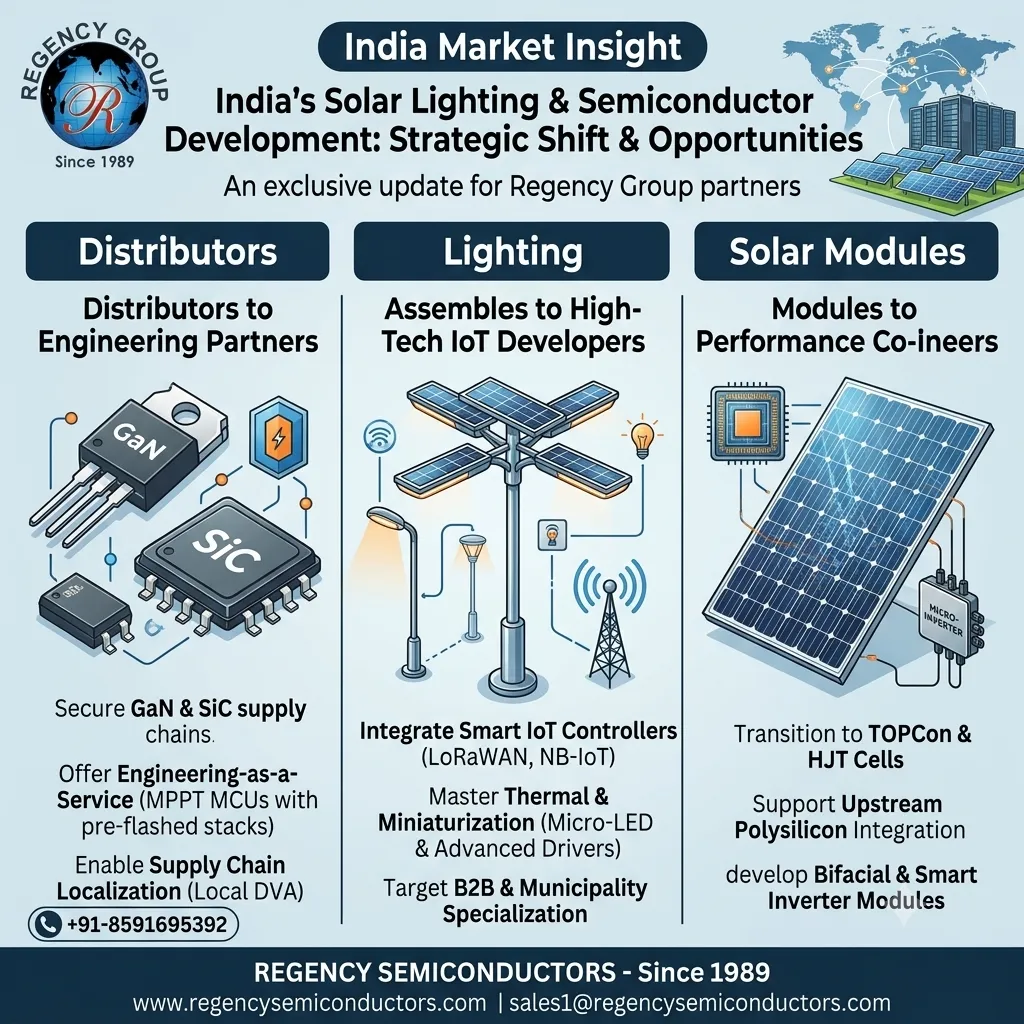
As a leading semiconductor distributor in India, we see firsthand that distributors are evolving from basic component brokers into highly specialized local engineering partners. The demand is shifting rapidly from commodity silicon to advanced wide-bandgap and optoelectronic components.
- Portfolio Re-alignment toward GaN and SiC: Traditional silicon components are rapidly losing ground to Gallium Nitride (GaN) and Silicon Carbide (SiC) chips. Distributors must secure strong franchises with global and emerging domestic foundries to supply these high-efficiency power ICs.
- Engineering-as-a-Service (FAEs): Lighting and solar manufacturers require microcontrollers (MCUs) capable of managing complex Maximum Power Point Tracking (MPPT) alongside IoT protocols. Distributors who bundle chips with pre-flashed software stacks, reference designs, and technical support are capturing the market.
- Supply Chain Localization: Given India's strict Domestic Value Addition (DVA) compliance rules under PLI policies, local warehousing and buffer stocks are critical to insulate domestic manufacturers from volatile global lead times.
2. Impact on Manufacturers of Lighting Systems
Indian luminaire and lighting fixture companies are transitioning from basic LED assemblers into high-tech IoT and smart hardware developers.
- Integration of Smart IoT Controllers: Standard standalone solar lights are being replaced by central, cloud-managed grid networks. Manufacturers must integrate low-power communication chips (LoRaWAN, NB-IoT, BLE) to support adaptive dimming, real-time battery diagnostics, and automated fault reporting for smart city projects.
- Thermal and Miniaturization Engineering: Moving to high-efficacy Micro-LED and advanced drivers requires robust thermal management. Indian lighting brands must redesign their physical chassis to accommodate tighter, hotter, and more dense semiconductor layouts.
- B2B and Municipality Specialization: The primary driver for solar lighting in the subcontinent is public infrastructure (national highways, rural electrification, smart municipalities). Winning these tenders requires long-term component durability warranties, forcing lighting brands to rely on tier-1 automotive-grade or industrialized semiconductor parts.
3. Impact on Solar Panel Manufacturers
For solar module manufacturers, the semiconductor boom presents an opportunity to upgrade performance and break free from a crippling reliance on imported raw materials.
- Transition to Advanced Architectures (TOPCon & HJT): Standard silicon cells are rapidly giving way to high-efficiency Tunnel Oxide Passivated Contact (TOPCon) and Heterojunction Technology (HJT) cells. Panel manufacturers must retool their assembly lines to handle these advanced semiconductor layers, which push solar conversion efficiencies beyond 22–25%.
- Upstream Polysilicon Integration: India has long suffered a bottleneck by importing nearly 100% of its solar-grade polysilicon from China. New domestic policy updates prioritize high-purity polysilicon production, creating a shared raw material supply chain that feeds both high-efficiency solar cells and the domestic semiconductor wafer industry.
- Bifacial and Smart Inverter Modules: Solar panels are increasingly paired with integrated, miniaturized micro-inverters or DC-to-DC optimizers attached directly to the back of the panel. Module manufacturers are transforming simple panels into active 'smart panels' that communicate directly with energy storage systems.
Comprehensive Market Matrix (2026–2030) Industry Segment Strategic Priority (2026–2030) Core Semiconductor Tech Needed Primary Policy / Market Driver
Semiconductor Distributors Pivot from component supply to localized engineering/software-bundling. GaN/SiC power ICs, 32-bit MCUs, NB-IoT modules. India Semiconductor Mission (Semicon 2.0) Lighting Manufacturers Shift from basic LED assembly to intelligent, networked outdoor systems. Smart sensor chips, edge processors, micro-LED drivers. Smart City Tenders & Rural Electrification Solar Panel Producers Move from low-margin modules to high-efficiency TOPCon/Bifacial panels. N-type silicon substrates, Perovskite overlays, integrated micro-inverters. High-Efficiency Solar Module PLI & Polysilicon Schemes
Partner with Regency Semiconductors Pvt Ltd
As the Indian landscape accelerates toward intelligent, high-efficiency solar lighting under Semicon 2.0, aligning with the right supply chain partner is crucial. Regency Semiconductors Pvt Ltd is your trusted authorized franchise distributor, bringing deep localized engineering support, prompt delivery, and advanced components to power your next generation of smart solar solutions.
Ready to dig deeper into the future of solar technology? Contact us today to:
- Explore specific government incentive schemes (like SPECS or DLI) available for your specific business model.
- Review a technical breakdown comparing how GaN vs. Silicon impacts solar charge controller design.
- Map out the key domestic competitors currently setting up fabs and testing facilities within India.
Contact Us
Regency Semiconductors Pvt Ltd
📞 Phone: +91-8591695392
✉️ Email: sales1@regencysemiconductors.com
🌐 Website: www.regencysemiconductors.com
Keywords